Thursday, October 10, 2013

Ashtanga Yoga - Is it right for you?

Ashtanga Yoga is the type of yoga which was urbanized and founded by K. Pattabhi Jois. This kind of yoga is known as the Eight Limb Yoga which has revolved in Pattanjali's massive idea. It presented that the path of purification is made up of the eight spiritual practices.
Ashtanga Yoga - Is it right for you?

Ashtanga Yoga is the type of yoga which was urbanized and founded by K. Pattabhi Jois. This kind of yoga is known as the Eight Limb Yoga which has revolved in Pattanjali's massive idea. It presented that the path of purification is made up of the eight spiritual practices.

The first four limbs that represent Ashtanga Yoga are - yama, niyama, Asana and the Pranayama. These are considered cleansing practices which are externally correctable. The other set of limbs which are the - pratyahara, dhyana, dharana are the internal practices. 

These limbs can only be corrected by the appropriate application of the Ashtanga Yoga method. This type of yoga method is quite dangerous to the mind. 

K. Pattabhi Jois said that practicing these Eight Limbs and also its sub-limbs of the external practices which include the niyama and yama is not possible. In doing so, the body should be strong enough so that it can perform the practices. If the body is weak, and the sense organs are not functioning well, practicing will never be useful to the person at all. 

The philosophy which K. Pattabhi Jois has applied is that you must keep in mind that after doing this Ashtanga Yoga the body will improve and it will be stronger and healthier.

Vinsaya and Tristhana are practiced in Ashtanga Yoga.

The Vinsaya is a style that makes Ashtanga and its principles discrete from the others. Vinsaya means the movement and breathing which is used for the internal cleansing process. Each movement done is accompanied by only one breath. Sweat is the most important product of Vinsaya. When you produce sweat, it only means that you are successfully applying the practice. When you perform the Asanas, the body creates heat which causes your blood to boil and excrete the toxins outside of your body. The toxins are found in your sweat. So the more sweat you create, the more toxins are released. 

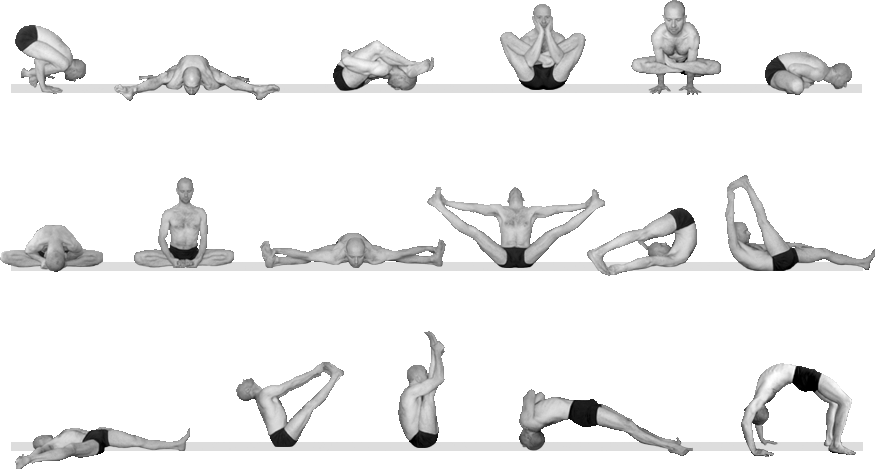
These yoga poses are used to fully develop the strength and health of the body. The series of practices make this possible. There are three postures used in Ashtanga Yoga.

The three are classified on different levels.

The first is the Primary Series which aims on aligning the body and also detoxifying it. 

The second is the Intermediate Series opening and cleaning the energy channels which comes to the process of purifying the Nervous System.

The last series would be the Advanced Series from A to D. in this series, the grace and strength is measured. 

The Tristhana is another yoga principle which represents the union of the three places of action and attention. First is the posture, second is the breathing technique ad last is the Dristhi of the Looking Place. All these three should work altogether to perform a function. 


Breathing techniques are simultaneous and synchronized. It is important to make a single breath for one movement. Ujjayi Breathing is the Yoga Breathing Technique used in the application of Ashtanga Yoga. Applying this technique must be prolonged after every practice. What you need to master is holding your pose longer at the same time hold your breath. This is an amazing breathing exercise that will increase your internal fire and will strengthen the Nervous System. 

And you thought Yoga Was Just Stretching | Yoga Li...


7 Best Important Tips for Yoga Success


Both Ashtanga and Tristhana deal with the series of Dristhi. The Dristhi is described as the point on which you gain your focus or attention while doing the Asana. This enables your mind to be purified and stabilized clearly. 

Setting the mind clear and cleansing it can only be done in the Eight-Limb Yoga or Ashtanga Yoga.

Wednesday, October 9, 2013

Ardha Kurmasana - Half Tortoise Pose

Ardha Kurmasana is also known as Half Tortoise Yoga Asana. Due to its resemblance to a tortoise it is known as the tortoise pose. This yoga asana can prove to be very beneficial to your body in every possible way. By performing this asana regularly and properly our bodies can be rejuvenated. The organs get stretched to its maximum with every movement of this asana.
Ardha Kurmasana - Half Tortoise Pose

The shoulder movement gets improved and so does the muscles in the corresponding areas. The abdominal muscles...
Ardha Kurmasana is also known as Half Tortoise Yoga Asana. Due to its resemblance to a tortoise it is known as the tortoise pose. This yoga asana can prove to be very beneficial to your body in every possible way. By performing this asana regularly and properly our bodies can be rejuvenated. The organs get stretched to its maximum with every movement of this asana.

The shoulder movement gets improved and so does the muscles in the corresponding areas. The abdominal muscles gets toned and become more flexible. The asana stretches the lower part of the lungs which is good for your breathing. It also increases the lung capacity which proves to be crucial if you have breathing problems like asthma. The pressure put on your neck and head improves migraine problems. It can be stated as a stress buster due to its stress relieving capacity.

Stomach related problems are solved too. If you suffer from indigestion or constipation this asana helps to improve it greatly. The digestive system is up and running with the help of the asana. Fresh supply of blood is provided to each and every organ for a smooth flowing bodily system. It relaxes the brain by the fresh supply of blood. Many of your sleeping problems are addressed by performing this asana. It is a good cure for insomnia.

Backache problems can termed as a thing of past. Ardha Kurmasana stretches the spine which relieves you from any backache or spine problems. Due to the level of blood circulation, your heart remains fit and fine. The bending and stretching increases the level of flexibility of your arms and hips. Toning gives great shape to your body which keeps you positive and healthy.

The internal organs are massaged very well to bring the extra zest needed for your body. It serves as a great remedy for anemic as well as diabetic patients. The pressure on the thigh and legs makes it strong and sturdy. It also tones the thigh muscles due to the position in which the asana is done. The spine is elongated by the stretch provided during the asana. It is a benefit in disguise, as it cures many ailments.

Warning: The reader of this article should exercise all precautions before following any of the asanas from this article and the site. To avoid any problems while doing the asanas, it is advised that you consult a doctor and a yoga instructor. The responsibility lies solely with the reader and not with the site or the writer.

Tuesday, October 8, 2013

Alternate Your Strength Training Workout With Some Yoga

Many who think of strength training equipment think of the massive muscles that many bodybuilders get and consequently show off in competitions. This can be a plus or a drawback for many consumers. The average consumer likes to be able to say feel good about themselves when they go swimming, but many are concerned about building too much muscle and suffering from stereotypical viewpoints. This needn’t be a worry for anyone considering strength training equipment.

The avera...
Alternate Your Strength Training Workout With Some Yoga

Many who think of strength training equipment think of the massive muscles that many bodybuilders get and consequently show off in competitions. This can be a plus or a drawback for many consumers. The average consumer likes to be able to say feel good about themselves when they go swimming, but many are concerned about building too much muscle and suffering from stereotypical viewpoints. This needn’t be a worry for anyone considering strength training equipment.

The average body builder works out a lot in order to get the muscles they are famous for, plus they have to be on a very strict regimen with lots of protein and little or no fat. It would take you a lot of effort to become as built as the average bodybuilder. Many consumers can use simple free weights in order to maintain the muscle mass that they have or to add a little muscle strength. Some use strength training equipment to add a little tone or shape to certain areas of the body.

If you use them properly and alternate your strength training workout with some yoga or stretching exercises there is little risk of you bulking up too much. Many find that they enjoy the challenge of working out with strength training equipment. You can gradually increase the weight as you work out over a period of time and after your workout you really will feel the ‘burn’ in your muscles.

Though you should be careful of using too much weight at once. Its easy to sprain a muscle and hurt yourself, putting you out of commission for a few days or more. A good rule of thumb is that if you think you can start out with a certain weight begin about five or even ten pounds lighter and after a few repetitions move up to the next weight level. You can check out strength training equipment reviews online for an idea of what others are doing.

Anuloma-Viloma - Yogic Breathing For Better Health | Yoga Living

Swami Kuvalyanand once said: “Yoga has a message for the human body, for the human mind and the human spirit.”
Anuloma-Viloma - Yogic Breathing For Better Health   | Yoga Living

This is a truism as a healthy body is the prime requisite for success and happiness in life. People are increasingly being convinced that yoga makes for good health, contentment and happiness in present day stressful life and is not just an exercise regimen.

In this article we will discuss Anuloma-Viloma (alternate breathing) pranayama. Pranayama simply means p...
Swami Kuvalyanand once said: “Yoga has a message for the human body, for the human mind and the human spirit.”

This is a truism as a healthy body is the prime requisite for success and happiness in life. People are increasingly being convinced that yoga makes for good health, contentment and happiness in present day stressful life and is not just an exercise regimen.

In this article we will discuss Anuloma-Viloma (alternate breathing) pranayama. Pranayama simply means proper ‘management’ of the vital force - prana. Although the basic principle remains the same, many different types of pranayama have been devised, each with its own unique technique. Anuloma-Viloma or nadi shuddhi pranayama (nerve purifying pranayama) is one such kind and is considered one of the basic forms.

The practice of Anuloma Viloma is somewhat like the squad that regulates traffic on roads, looks after their cleanliness, beautification, etc and keeps the traffic moving smoothly and efficiently. The method involves breathing in (pooraka) through one nostril and vice versa. Therefore this pranayama has the name anuloma viloma, i.e. alternate breathing.

To practice this, you have to sit in any of the yogic sitting postures. To begin with, carry on normal breathing applying moola bandha (i.e. comfortable anal contraction). Keeping a stable moola bandha, breathe in and breathe out completely. Ensure that the moola bandha is not loosened during the process. Pause for a while between breathing in and breathing out. Breathe in deeply through the left nostril and breathe out through the right; then breathe in through the right and out through the left. Continue breathing this way, i.e. alternately from left and right nostrils, for one to three minutes.

After reaching a comfort level in this way, you may move to the next stage. Close the right nostril with the right thumb keeping the other four fingers together. Now, slowly breathe in through the left nostril at a uniform speed. Repeat with the other nostril. While breathing in, raise the shoulders and expand the chest taking the ribs up. The lower abdominal region, however, must be held in.

Benefits: The respiratory passage is cleaned and this prepares one well for the practice of other pranayamas. Breathing becomes easy and regulated. The mind becomes and heartbeat rhythmic. Also aids in enhancing concentration, memory and other mental faculties.

Contraindications: Severe pain in abdomen, swelling on account of appendicitis, enlargement of liver, very delicate bowels or intestines, disorders of the lungs, severe throat infections, growth in the nose (polypus) or blockage of the nasal passage due to cold, etc.

Warning: The reader of this article should exercise all precautions before following any of the asanas from this article and the site. To avoid any problems while doing the asanas, it is advised that you consult a doctor and a yoga instructor. The responsibility lies solely with the reader and not with the site or the writer.

And you thought Yoga Was Just Stretching | Yoga Living

What was once ridiculed as a bizarre fad is today seen as a basic skill and many people who looked upon Yoga as a stunt or physical regimen set aside for only the flexible have now accepted it as a way of life. With its combination of poses, breathing exercises and principles, Yoga, my friends is way more than just a stretching routine.
And you thought Yoga Was Just Stretching | Yoga Living
While on the way to spot a friend of mine at the local YMCA, he asked why I didn’t just join the gym and I explained to him that I practice Yoga and occasional calisthenics at home for my exercises and really didn’t feel the need for a gym membership. His response was predictable: “Yoga…isn’t that just stretching?”

I smirked at the familiarity of the question and proceeded to explain to him the theme of this article. As I told him and for those who may not know otherwise: No, Yoga is way more than just stretching or getting into supposedly awkward looking poses and positions.

It is a combination of stretching, breathing exercises, meditation and perhaps the most overlooked limb, adherence to a proper diet.

The word yoga, from the Sanskrit word yuj means to yoke or bind and is often interpreted as a "union" or a method of discipline. Its ultimate goal is the union of man with God or the universe in one breath. Furthermore, it aims to liberate the spirit as the mind and spirit are equally involved in its practice. 

Yoga is indeed the oldest existing physical-culture system in the world. Besides being a systematic and scientifically proven path to attaining physical fitness, it delays aging, rejuvenates and improves one’s appearance, maintains suppleness and increases vitality and the creative part of life.

With its core warm-up exercises known as the Sun Salutations (which are somewhat similar to the calisthenics exercise known as ‘burpees’), the inversion poses, forward and backward bending poses, balancing exercises for the arms and building focus, the average practitioner will attest to the fact that for attaining fitness, Yoga can stand its own.

Think Yoga can’t help with building strength? Think again. Heck, I challenge the most adept body-builder to hold the simple yet powerful peacock-pose for 90 seconds straight. Bet you they’d crash half-way in its execution-if they make it that far.

Yoga also offers unique breathing exercises which are wonderful for patients with respiratory disorders and even singers and public speakers, moreover with its unique relaxation pose, oft times practiced during and after its execution, Yoga offers a systematic means of deeply relaxing the entire body perhaps the way no other exercise can. (Keep in mind of course that several of the poses give a deep body massage not unlike the ones received in salons…just thought I should throw that in.)

With countless books, DVD’s, videos and classes being offered for all ages, levels of fitness and experience (some of them being actually free for the first couple of lessons to try Yoga out), I suggest you give it a trial and see for yourself what it can do.

One thing I promise you is this; you will walk out of your class and nod in agreement that indeed: “yoga is way more than just stretching.” It is THE exercise.

Monday, October 7, 2013

7 Best Important Tips for Yoga Success

Yoga has been proven to relieve stress by using exercises that unify the mind, body, and spirit. If you are new to yoga, these seven tips will start you on the road to a more centered life.
Yoga has been proven to relieve stress by using exercises that unify the mind, body, and spirit. If you are new to yoga, these seven tips will start you on the road to a more centered life. 
7 Best Important Tips for Yoga Success

1. Talk to your doctor and explain what type of yoga poses you intend to practice. Show your doctor pictures of the poses for illustration. Your doctor may rule out specific poses if you have high blood pressure, glaucoma, a history of retinal detachment, or heart disease. Make sure you follow your doctor’s recommendations. 
2. Find a yoga class that best fits your abilities. Talk to prospective teachers, and decide whether of not you can handle a program before you sign up. It’s very important to take it one step at a time. Try a few beginner classes before you attempt more vigerous classes. Don’t move ahead too quickly. Allow your body to adjust to your exercises.

3. Listen to your body and be aware of your physical abilities. You don't want to hurt yourself. Make sure the instructor understands your level of experience and any limitations you may have. Don’t allow anyone to push you ahead too quickly. Remember, this is supposed to be fun and relaxing.

4. If you can’t find a class that meets your needs, you can always practice yoga at home. There are many books, programs, and tapes available to help you get started. Search for the best products on the Internet and read reviews. Talk to others for recommenations.

5. Why not try private lessons? You can book some one-on-one sessions with a teacher in your area. Most yoga instructors offer private classes or can help you design your own program. This is a good way to get started. You can always take group lessons or practice at home after you’ve had private lessons and learned the basics.

6. Find a yoga buddy. It’s nice to practice with someone and it will help reduce injuries. It’s also a great way to keep up your enthusiasm and interest.

7. Eat lightly before practice. Wait at least two hours after meals before yoga class or practice. An empty stomach is best, but don’t let yourself get too hungry to think. You won't be able to focus on the poses or enjoy yourself during the relaxation or meditation exercises.

Now it's time to grab your mat and a towel and get the most out of your yoga exercises.


Wednesday, October 2, 2013

The Drama of a Yoga School As a Business

So, you want to open a yoga school? The popularity of yoga is a huge incentive for people of all walks of life to become a yoga teacher, teach as an independent contractor, start a yoga school, or leave their day jobs behind. However, what looks easy to many people needs some planning. Businesses open and close in a few months because of bad locations, no business plan, there are not enough funds to sustain a start up, marketing budgets, and many more possibilities.


Obtaining Certification


According to industry standard, the first step on your journey to launching your own yoga school should be to obtain certification as an instructor from an accredited institution. Becoming certified usually means that you are in for a big education. For years, nobody was certified until yoga instructors realized that they could be sued. That's right - in some countries, suing is like the lottery. Today is your lucky day, because you can sue anybody for anything. Lawyers love it, while some people diligently plan and scheme for their opportunity to take anybody to court.


What can yoga instructors do? Get certified, get covered by a liability insurance company, and establish a track record of safe procedures in your classes. Registration is an option, but it's not often required for liability insurance. To be honest, some teachers (who are not certified or registered) have sports liability insurance coverage. However, certification does show that you are formally educated in safely teaching yoga classes. So, that does build your credibility as a yoga teacher who cares about student safety.


Create A Plan Of Action


Once you are certified, research the fees charged for yoga instruction in your demographic, to stay competitive and create a plan of action! In addition, you must decide if you would like to be the sole proprietor of your yoga school, be a partner, incorporate or run a limited liability company. It is essential to work out the details of this part of the business since new instructors income may vary from $30,000 to $70,000 a year. As a sole proprietor, you can build a private clientele to gain exposure and build rapport that may actually prove more lucrative.


There is also the option to be an independent contractor. As an independent contractor you can work as a sole proprietor from an existing building, such as a private health club, or fitness center, with a built-in clientele, to avoid the overhead costs associated with renting your own building and paying for staff. You will also need to determine what type of yoga you will teach at your school and specialize in that. In a health club, people want to achieve different things through yoga and may not choose to participate in yogic breathing or meditation, but may prefer the physical flexibility and strength training aspect of this discipline instead. Popular yoga workouts for fitness centers include Vinyasa, Hot Yoga, Ashtanga and Power Yoga.


Where's the Drama?


Regardless of the path a yoga business takes, there are some key factors to be mindful of: Seek the credentials and licenses needed to get started, choose a plan of marketing, the type of yoga that will best suit your clients, and carefully advertise your business based on your chosen discipline. In addition, purchase insurance that covers the type of yoga school you are running, to protect yourself legally.


True to ancient yogic philosophy, it takes a lot of dedication and hard work to make any business a reality. Beyond the poses, meditation, spiritual enlightenment, mantras, and breathing exercises, yoga has become increasingly trendy, and is now an industry, according to the New York Times. The drama is the daily management of time, energy, personalities, and money. If you think becoming a yoga teacher has nothing to do with business, you will be in for a big surprise.